

Friends of the pixel and the couch! Let me begin with a confession: for years, I considered myself an image purist. A staunch defender of horizontality. If I saw someone recording a video vertically at an event, I felt a pang of aesthetic pain. We called it the "Vertical Video Syndrome," and it was the epitome of digital amateurism. Well, if that was the banner of resistance, Meta has just raised the white flag—or perhaps a black flag—over the coffin of traditional television.
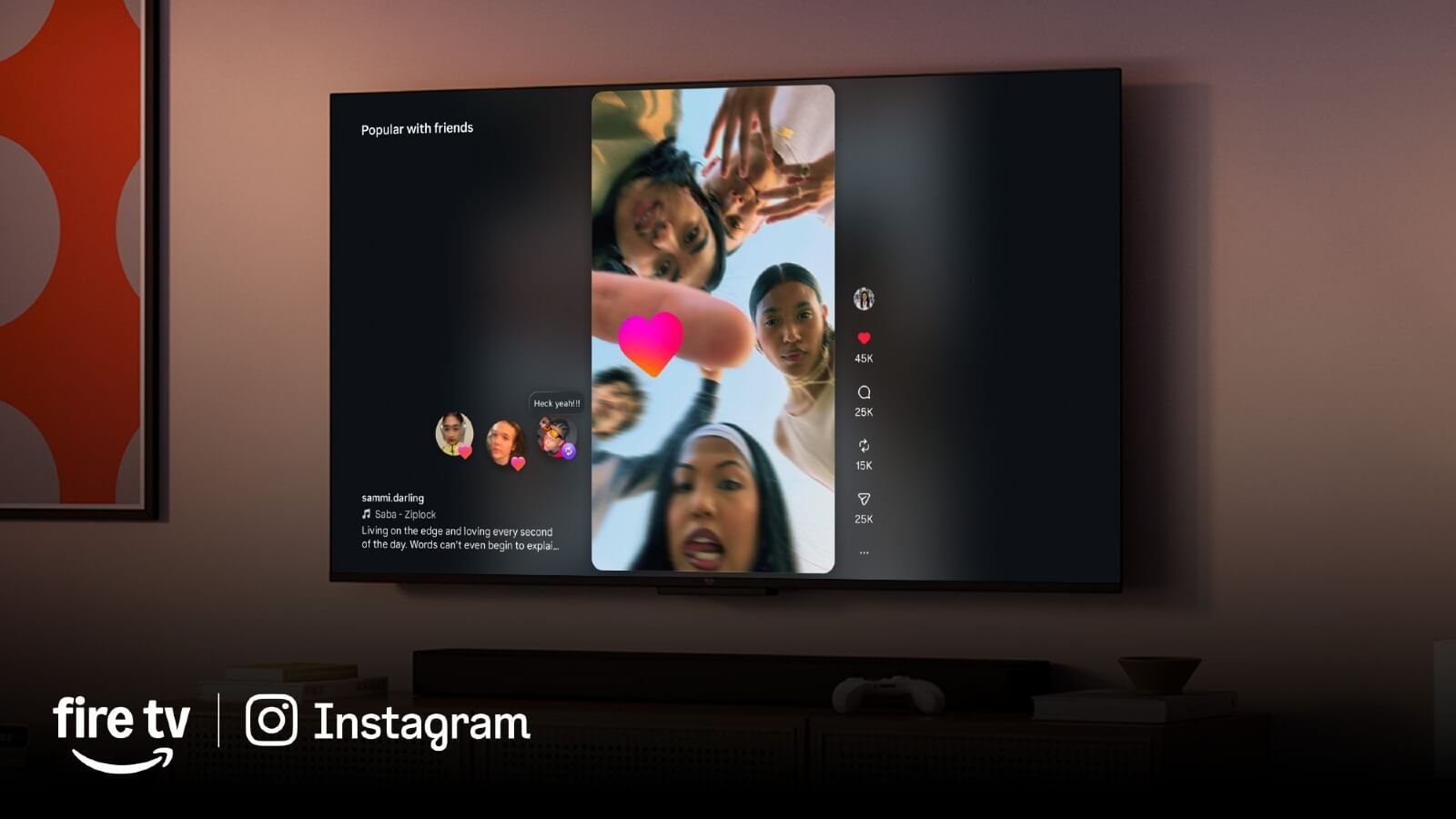
The news, though seemingly small, is a silent earthquake: Instagram has launched a dedicated app for televisions, starting with Amazon Fire TV devices. But it's not an app for viewing photos or long IGTV streams (which, let's be honest, never really took off). It's an app whose main focus is, you guessed it, Reels! The short, addictive, vertical video, designed for the palm of your hand, is now leaping onto the biggest screen in the house. And this, dear readers, isn't just a product expansion; it's a tectonic shift in our culture of audiovisual consumption.
The Invasion of the Black Frame: When Verticality Challenges Cinema
Let's talk first about the major technical inconvenience, the elephant in the room: How on earth does a vertical video look on a 65-inch TV? Meta's answer is an exercise in brutal pragmatism: letterboxing The vertical video takes center stage on the screen, and the dead space—that dark, depressing strip on either side—is filled with key information: description, likes, comments, and account details. Essentially, they haven't just brought video to television; they've brought the entire user interface, the social ecosystem that brings it to life.
This decision is crucial because it reveals Meta's priority: social experience takes precedence over visual quality. They could have forced a crop, a zoom, or required creators to adapt their content (as YouTube initially did). Instead, they've said, "This is how we consume content on our phones, and if we're going to compete for your TV time, you'll have to consume our format as is." What we're seeing isn't Instagram adapting to TV; it's TV adapting to Instagram's rules.
The sofa has traditionally been the epicenter of the "lean back and relax" experience (the famous lean back ), where we turned on Netflix, HBO, or cable television, expecting to be served up with long, well-produced narratives. Instagram, with its 4K Reels, is importing the culture of "active scrolling" (the scroll culture to the passive environment. Now, that algorithmic dopamine rush is available just by turning on the television, ready to trap us in an endless loop of 30-second clips, going from a travel hack to a viral dance, and then to a snippet of sports news, all without us having to lift a finger to look for the next stimulus.
Meta Seeks Control of the Living Room: Goodbye to "Netflix and Chill"?
Meta's ambition in entering the connected TV (CTV) space goes far beyond simply offering another way to watch kittens. It's a strategic move for territorial dominance. The time we spend watching video is finite. If people are increasingly consuming short-form video, Instagram needs to ensure that consumption continues on its platform, regardless of the device. If TikTok was already experimenting with TV interfaces, Instagram simply couldn't afford to be left behind.
But there's a very interesting nuance that differentiates this foray from previous failed attempts (like the aforementioned IGTV). Instagram's new TV app is organizing content into "channels." Yes, channels. There will be thematic groupings like "new music," "sports highlights," "travel gems," and "trending moments." This isn't just a feed giant algorithmic; it is a reinvention of the programming guide.
By introducing channels, Meta is doing two brilliant and terrifying things at once. First, it's offering a familiar consumption model for generations who grew up with cable television, making it easier to navigate thematically in a sea of ephemeral content. Second, it's positioning Instagram, the platform, as an essential content curator, an intermediary that dictates which trends deserve mainstream attention. This grants immense power over content distribution and monetization, transforming the platform from a social network into a de facto media distributor.
The Sense of Community and the Death of Digital Loneliness
Another element that underscores the importance of this move is the focus on shared consumption. Instagram has stated that "they heard from our community that watching reels "Together is more fun." This phrase encapsulates a sociological truth: technology, which has often isolated us, forcing us to stare at our phone screens in solitude, now seeks a communal, or at least familial, affirmation.
The television is, by its very nature, a communal device. When we enter the living room, we're not looking for solitude; we're looking for a meeting point. By allowing up to five accounts to log in and by customizing the feeds Out of self-interest, Instagram is making it easier for scrolling to become a group activity. Imagine the scene: a family or group of friends sit and watch a curated stream of clips, laughing together or commenting in real time (probably using their phones as a second device, an irony we're not unaware of).
This is the platform's subtle trap: it transforms ephemeral content, designed for fleeting attention, into a social glue. It's no longer just "look at this I found on my phone"; now it's a shared experience, a constant backdrop of micro-entertainment that competes with silence and, of course, with movies that demand an hour and a half of uninterrupted attention.
Furthermore, this integration could be a boon for content creators. Access to the big screen signifies validation, proof that their work, however short and vertical, carries the same media weight as a Hollywood production. Monetization on CTV is traditionally more lucrative, and if Instagram manages to attract high-profile advertisers to its themed channels, the creator ecosystem could experience a significant boom, elevating short-form video from a hobby to a professional career with massive home reach.
Cultural Normalization and the Future of Our Care
What we're witnessing is the final surrender to the vertical format. For the past decade, movie and television screens have tried to maintain their horizontal authority, their cinematic heritage. But the generation growing up with TikTok and Reels considers the vertical format as natural as breathing. Meta is simply serving its audience where it is, even if that means a visual compromise that makes purists' eyes bleed.
The launch of this application on televisions is not just an addition to our catalog of streaming It is the monument to the victory of the attention economy. By migrating the addictive experience of scroll From the comfort of our sofas, Instagram ensures that even in our "passive" leisure time, our minds remain in constant search mode for the next dose of instant gratification. The dominance of the short, the fast, and the algorithmically perfect is consolidated to keep us glued to the screen, whatever its size.
Television is no longer a window to a narrative world; it is the magnified window of our phone, a giant portal to feed Globally, television as we knew it may not die, but it is certainly transforming into something radically different. We are moving from choosing what to watch to being served by an algorithm that knows, better than we do, what will keep us watching. The question that remains is: in this new era of vertical content, where attention spans are measured in seconds, what space is left for deep, thoughtful storytelling, and are we sacrificing the capacity for reflection for the tyranny of the click and the swipe?